
1. Introduction
Writing this thesis turned out to be harder than expected. Although the subject is gaining ground in academic circles in the Netherlands and America, there is remarkably little source material to be found. David Nieborg - PhD student and junior lecturer in Media Studies at the University of Amsterdam - describes the situation as follows:
Scholars and game developers abroad with whom I have been in contact, in person or by e-mail (such as Dr. William Uricchio, Professor of Film and Television History at Utrecht University and Professor of Comparative Media Studies at the Massachusetts Institute of Technology), could hardly help me with books or articles on the subject. Their answer was almost always that they get most of their material from study days and conferences. Unfortunately, study days specifically about this subject are still very scarce in the Benelux. Outside the Benelux there are of course such events, but one can hardly expect me to travel to Hong Kong[3], for example, to bring this thesis to a successful conclusion. I did have the opportunity to take part in a symposium in Leiden, where a number of lectures on game research provided relevant information.[4] Moreover, the majority of the people with whom I discussed my thesis research (fellow students, for example, whether or not gamers themselves) found it hard to connect the notion of history with computer games. As a result, the subject of my thesis has been broadened from purely historical representation to a general picture of history and computer games. This somewhat benefits the aim of this thesis: to write a basic work on which further research can be built.
This thesis happens to appear in an anniversary year for computer games. The console phenomenon is, after all, forty years old this year[5]. The year used as the pivotal date is 1966. That was when Ralph Baer developed a system for playing games on a television set, whose best-known game became Pong (see 4.3.2). From 1972 onwards the game console began to conquer the living room. Since then, the trade in and popularity of games have grown steadily.
2006 is also an important year for another reason. The three big players in the field of game consoles are all bringing their latest consoles to market this year. Microsoft has already given us the Xbox 360, Nintendo is coming up with the Nintendo Wii and Sony is placing the PlayStation 3 in our living rooms. A great deal has changed since the very first consoles, which is why scientific research in this direction is really starting to become interesting.
Computer games, however, have taken a long time to lose their negative stigma. Only ‘nerds’ occupied themselves with this new form of entertainment, and ordinary people quickly looked down on them. This view, which was certainly omnipresent until the mid-1990s, still turns out to rear its head today. In recent years, for example, there were a few reports in the Flemish current-affairs programme Koppen on the VRT that reflected a negative image of games and their players. It must be said that these were highly subjective reports that fixated on a very small aspect of gaming, but through which the stigma is confirmed again and again for the non-playing world. Fortunately, public opinion has been slowly changing in recent years. Games are no longer a marginal phenomenon. The revenue of the industry proves this. More money circulates in the gaming world than in Hollywood,[6] something that has of course not escaped filmmakers. One consequence is the boom in film-to-game and game-to-film adaptations. Unfortunately, it has to be mentioned that the derived product is often of much lower quality and trades on the name recognition of the original. I will not go further into this aspect, however. A study by the American Entertainment Software Association[7] has shown that the average age of the gamer has risen to 30, while 19% are older than 50. The medium has thus grown up together with the young people who grew up with it. Contrary to what many claim, computer games are therefore not only popular among the young and must consequently be recognised as an important component of present-day popular culture. In addition, a study by the Interactive Software Federation of Europe[8] shows that one in three Europeans regularly comes into contact with computer and video games.
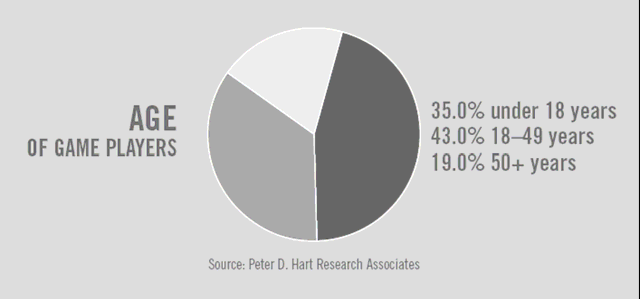
Figure 1: Percentage by age[9]
Yet profit figures and popularity alone are not enough to take the ‘historical value’ of computer games seriously. Scholars also note the cultural and social importance of computer games. The bibliography on computer games is growing steadily, fed by research in literature, media studies, history, art history, social history and, of course, game development. Organisations such as the Digital Games Research Association (DiGRA)[10] in Europe and the North American Simulation and Gaming Association (NASAGA);[11] online journals such as Game Studies and the International Journal of Intelligent Games & Simulation; and teaching and research programmes at MIT and many other universities all testify to the growing scholarly interest in the study of the computer game and related interactive media. Research into the social and cultural impact of interactive entertainment is gradually replacing the dismissal of computer and video games as mindless amusement for young boys. In summary, we can state that
- the game industry generates enormous revenues and profits and has grown into an essential and innovative part of the global media industry
- the game industry is recognised by other creative and technological sectors as an important stimulator of technological development
- games form an increasingly important part of young people's leisure time and of youth culture
- the creative possibilities of computer simulations go a good deal further than those of traditional media and have meanwhile been embraced by many young artists and creative companies.
We therefore cannot but acknowledge that computer games are beginning to have a great influence on their players. The media often refer to the influence of games in the area of violence, a subject that is only too eagerly seized upon. But the influence on perception and imagery need not necessarily be bad. Quite a few games have a historical background, so it seems logical to conclude that games can have considerable influence on historical imagery, just as historical films influence general imagery. I am aware that my own view of history and of specific historical events has been largely influenced by various computer games, just as historical films influence the film lover.
[1]Visual Arts Professor and Director of the Center for Research in Computing and the Arts at the University of California, San Diego. See ‘Essential Facts about the Computer and Video Game Industry - Sales, Demographics and Usage Data’. ESA (Entertainment Software Association), 2005.
[2]Nieborg (D.), ‘Spelend leren. De ontluikende relatie tussen wetenschap en games’ [Learning through play: the emerging relationship between science and games], De Academische Boekengids, 53, 2005 (in Dutch; the quotation above is translated). (http://www.academischeboekengids.nl/do.php?a=show_visitor_artikel&id=421).
[3]13/14 March 2006, ‘New Heritage Conference: Cultural Heritage and New Media’, Hong Kong.
[4] ‘Game Over! Games en Geschiedenis’ [Game Over! Games and History], study day organised by the Vereniging voor Geschiedenis & Informatica (VGI) and the Stichting voor de Nederlandse Archeologie (SNA), on 31 March 2006. My report on that study day can be read in Brood en Rozen. Tijdschrift voor de Geschiedenis van Sociale Bewegingen, 2006, 2, pp. 87-89.
[5]2006
[6]Computer and video game software generated worldwide revenue of €1 billion in 2001, of which 6.7 billion in Europe alone. http://www.isfe-eu.org/
[7]Official website: http://www.theesa.com/
[8]Official website: http://www.isfe-eu.org/
[9]http://www.theesa.com/files/2005EssentialFacts.pdf
[10]Official website: http://www.digra.org/
[11]Official website: http://www.nasaga.org/