
3. The problem of visualising the past
3.1 Introduction
Before I begin the part that deals specifically with games and history, I first want to give a general picture of the problem of visualising the past, more specifically the historical Hollywood feature film, since it has an enormous influence on today's historical computer games.
3.2 Representation in audiovisual media
The Dutch term "beeldvorming" (image formation, or representation) refers to at least two things. On the one hand, the term refers to an active process in which the media form images of something, literally or figuratively. On the other hand, the term also refers to a certain state in which an image of something has been formed. In other words, historical representation can refer to:
- the study of the changes over a certain period and the image that ultimately remains. The image that sticks, about which a consensus exists. It is obvious that we cannot simply state that this image will not change in the future, but we can posit that the image in question has remained the same over a longer period
- the search for the origin of the image that sticks: when did that image arise, which factors led to that representation?
The image that many young people have today of Ancient Egypt or the Roman Empire has been formed by comics, historical novels, historical films or historical television series and, more recently, also by historical computer games – far more than by any study of those empires at school. So-called docudramas also play a role.
They usually give a more or less romanticised version of the facts, and in many cases old newsreels are even inserted to heighten the sense of authenticity. It is a fact, however, that commercial box-office hits are not necessarily the most historically correct films. Big spectacle films draw masses to the cinemas regardless of the numerous historical inaccuracies. Whether it concerns "historical" films, documentaries, computer games etc., that imagery is, for a large group of people, their only experience of history or of historical discourse. This illustrates the need for historians to become even more involved in audiovisual representation.
In recent years a good deal of attention has already been paid to film as a historical source[22] and to the role of television[23]. Much of that commentary can also be applied to other audiovisual media, in this case the historical computer game. Computer games enjoy growing academic interest, in America but also in Europe. If one checks the curricula of various scientific institutions, the influence of and interest in computer games turns out to be growing steadily. Traditional, reflective history and the modern computer game need not exclude each other. The relationship between history and computer games can take various forms:
- the history of the computer game
- the history in the computer game
- the problems that history poses for computer games and vice versa.
Computer games can be investigated by historians from various perspectives:
- analysing the dozens of choices the developers made to arrive at the presentation
- studying the game as a cultural artefact of the period in which it was made
- analysing the actual content.
The kind of history we encounter in computer games is first and foremost a matter of culture. It presupposes a very strongly generalising notion of the past rather than a bundle of demonstrable facts. From that point of view, games such as Rome: Total War are nevertheless valuable as history. Such games relate to Ancient Rome (or to the Middle Ages, or another historical period) in a clearly "fictional" manner, but they are in any case concerned with history. If one says that historical feature films can evoke a spirit of the age, that also applies to a high degree to games such as Rome. Especially in recent years the developers' enormous sense of detail is remarkable.
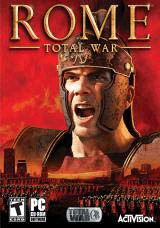
Figure 2: Rome: Total War
Much of the commentary on the relationship between history and film may apply without further ado to history and computer games, since both concern audiovisual sources. Yet I note an important difference: the film gives one version, one truth, the director's version. Many computer games, with their interactive "what-if" possibilities, allow multiple "truths". The player directs history himself.
The problematic relationship between the audiovisual medium of film on the one hand and history and professional historiography on the other has already been studied extensively.[24] Since a parallel with computer games can easily be drawn, it seems logical to me to give a short overview of the changing attitude of historians towards the medium of film as a historical source over the course of the 20th century.
Films dealing with historical subjects, events or persons have been (and often still are) viewed all too often with suspicion by professional historians and are immediately criticised for the way the historical facts are presented. The Hollywood film in particular gets a rough time. Historians especially dislike the deceptively realistic presentation in which fact and fiction run together. But it should be clear that the films that meet with no understanding from historians are precisely the so-called blockbusters. The popular historical film is therefore often the subject of the debate on whether or not it is possible to represent historical facts through visual representation. In other words, can film "write" history? The question that is always asked is whether film has any form of educational value and whether film can be used as a historical source. It cannot be denied that most films were not made for their "educational" value at all. These are always films made to reach a large audience, and profit maximisation is more than likely the greatest driving force. Those Hollywood films have to meet the needs of the Western culture industry: historical events are therefore turned into spectacle and history is simplified for the sake of the recreational aspect. History is therefore cast into an attractive story in which heroes and conflicts must not be missing. The negative criticism that historians spout about those so-called mainstream films has no influence whatsoever on their popularity.
History has always been fodder for films: from the silent film to today's blockbuster (in all kinds of forms, ranging from melodrama through action film to war film), but the influence of film on historical imagery was for a long time received negatively by historians. During the last quarter of the 20th century some historians began to take "cinematic history"[25] seriously. Society had changed to such an extent that historians could do nothing but follow the evolution. There was an enormous supply of films; television became immensely popular; later video was added, and today DVD and digital multimedia. Historians could no longer ignore that more and more audiovisual sources were reaching an ever larger audience. Although some traditional historians were not yet convinced (and still are not), some scholars began to show interest in these audiovisual media. The visualisation of the past in a number of popular films towards the end of the 20th century turned delicate historical events into a mass spectacle. An example of this is Spielberg's Schindler's List from 1993. Critics stood ready to label the work immediately as "cheap" fiction in which the truth was - once again - violated. It looked very much as if audiovisual representations of the past failed to render historical reality correctly. A turning point came with the American historian Robert Brent Toplin.[26] He described the relationship between history and film with an open mind. About his book, History by Hollywood. The Use and Abuse of the American Past (1996), Gregory Bush - the publisher of Film and History - wrote that it "opens a new window into the relationship between filmmakers and historians".[27]
It therefore seems that historians and film theorists today appreciate the approach to fiction film as reflections on the past. The boundaries between film and history are blurring. Historians are now open to the narrative strategies and fictional elements in describing history. They assume that films should not simply be treated like traditional written history, but according to their own criteria. The fact that historians previously always treated films in the same way as written history meant that what they wrote on the subject almost always concerned the historical "errors" in the films (which in fact I also do in connection with computer games - see further: 4.6 Historical representation in computer games). This approach, however, yields limited insight. If films are approached according to their own criteria, they can offer a great deal as messengers of history. The historical film (the historical computer game?) should therefore not be viewed as a substitute for written history, or as an illustration of written history, but as a supplement and an extension that gives depth to written history. But how should the subjectivity and the transformations of fiction films be approached when we regard films as serious messengers of history? The new approach to historical films sees films as interpretations of the past rather than as an objective description of the facts of the past. Historical films are poetic speculations about the past, and manipulating the historical film is a way of creating a wider truth - the overall interpretation is therefore more important than the detail. That is, for example, the view of the American historian Robert Brent Toplin.
3.3 Robert Brent Toplin
Robert Brent Toplin states very clearly that the popular historical film has a greater impact on the public's view than classic books, and that it is therefore important to look at those films (e.g. JFK, All the President's Men) analytically. He analyses how filmmakers have interpreted American history. Toplin recognises the danger of excessive artistic freedom and tries to gauge the strengths and weaknesses of the representation of history in the Hollywood film.
In 2002 Toplin published Reel History: In Defense of Hollywood.[28] The title leaves little to the imagination. Toplin analyses various historical films (including 12 Oscar winners for Best Picture) and posits that critics often do not (want to) recognise the unique way in which fiction films propagate important ideas about the past. He emphasises the fact that filmmakers cannot but simplify and adapt the historical facts because they have to conform to an enormously expensive mass medium (I dare not claim that developing computer games is as expensive as making such blockbusters, but I am convinced that the reasoning also applies to computer games - bearing in mind that a large team sometimes works for several years on the development of a game). The "creative adaptations" are precisely the problem for historians, but according to Toplin these films (and I extend this statement to historical computer games) often communicate a deeper symbolic truth to the viewer. The viewer must be able to appreciate the overall impact of the film and ignore the inaccuracies. A film like Saving Private Ryan, for example, indeed shows few factual details of the Second World War[29] but the film does succeed in effectively conveying the experience of combat. Toplin readily admits, however, that certain films (e.g. Amistad) contain so much fictional exaggeration and simplification that they really do deserve the criticism they received. He stresses that with historical films (and historical computer games?) content does matter: "content does matter".[30] A book remains superior to a film as a source of detailed information and analysis, but a two-hour film can arouse emotions and stimulate curiosity. But the fact remains that a film will appeal to an audience only if the plot is gripping rather than didactic (translated to computer games: the game must be exciting rather than "preachy").
As a historian, Toplin has built up a reputation in connection with the relationship between film, history and truth. In his most recent book, Michael Moore's Fahrenheit 9/11. How One Film Divided a Nation (April 2006), he analyses the controversial documentary about America's involvement in Iraq and examines its truthfulness and its influence on public perception.
3.4 Robert A. Rosenstone[31]
Robert A. Rosenstone approaches the historical film as a serious work of history and posits that the fictional elements of the historical film must be seen as ways of symbolising, condensing and complicating matters. A historical film may therefore not be judged solely in terms of historical accuracy and may not simply be dismissed because of fictional elements. The historical film must be taken seriously according to its own criteria: as an interpretation of the past and as a poetic speculation about the past. If the historical film is approached in that way, it offers an equally valid and sometimes even clearer representation of history than written history. But, like Toplin, he warns that not every historical film uses these possibilities properly.
A distinction must therefore be made between serious and non-serious historical films; between the mainstream historical film and the historical art film. To be able to make that distinction we must define the characteristics of the historical film. For the historical film to be taken seriously, we must eliminate certain films that take place in the past. There is nothing wrong with that in itself: historians usually do not hesitate either to leave out texts they do not find serious or scholarly. But what exactly is a historical film? It is important to underline that it is not a genre in itself. Although many historical films have a great deal in common, the plots can play out within entirely different genres. Saving Private Ryan and The Great Dictator (Chaplin's 1940 satire on Nazi Germany) are both historical films, but the differences between the two are unimaginably large. The only thing all historical films have in common is their reference to the past.
Rosenstone takes narrative conventions as the starting point of his research. The distinction he makes between the mainstream film and the art film forms a logical point of departure, since it is self-evident that different ways of telling a story offer different possibilities for expression. According to Rosenstone, the classical film offers history as drama. The film is based on cinematic realism, in which the viewer gets the idea that nothing has been manipulated. There is a beginning, a middle and an end, and this creates a sense of relief in the viewer. In the classical film the individual is placed centre stage, a cinematic means of emotionalising, personalising and dramatising the history/story ("(hi)story"). It concerns a closed, complete and simple past. The film is framed by landscapes, buildings and artefacts from the past. Finally, Rosenstone states that the classical historical film presents history as a "process". Unlike written history, which distinguishes different aspects such as economy, politics, race etc., the classical historical film describes history as "a process of changing social relationships where political and social questions - indeed, all aspects of the past, including the language used - are interwoven".[32] Together with the individualised standpoint, the image of historical films as process-oriented creates a sense of the past that one seldom finds in written history. The simplicity and the sense that nothing has been manipulated - central ingredients in this narrative mode - can, however, become problematic: too much simplification can be dangerous. When, in a film about the Holocaust, for example, there is too much simplification and the Nazis are portrayed as personifications of the devil, things go wrong. What the film needs to convey (the potential for genocide and the fact that many Nazis were people like you and me) is lost in the process. It is therefore important that the many facets that led to the Holocaust are conveyed in an open manner. Finally, we must not overlook here that those films are indeed manipulated: i.e. through editing.
The subjective position is one of the strong points of the art film. The artistic or experimental historical film is characterised by its reference to itself (the meta-level), that is to say that the film itself exposes the process in which the past is created, instead of simply describing the past. In contrast to the mainstream film, which usually opts for simple meaning, the experimental film wants to give a complex picture of the past. Typical of those films are abruptness, fragmentation and attempts to be "open-ended". Often there is a multitude of voices and there are different viewpoints, and different times and places. The art film tells the stories of the past in a more complex way and with more differentiation than the mainstream film. According to traditional historical standards, the art film is better able to represent the past effectively. The drawback is that this kind of film reaches only a fraction of the audience of mainstream films. The main advantage is the possibility of telling a story on different levels.
As a kind of conclusion we can state that, as mentioned above, we must accept the historical film as it is; that is to say, the norms suited to written history should not be blindly projected onto the historical film. But a critical approach is fundamental (as is the case with all other forms of history). The historical film must be seen as a means of conveying those aspects of the past that cannot be communicated by written history. From a phenomenological point of view we can therefore say that it is a feeling, a sense of the past, or a poetic speculation that constitutes the strongest part of the historical film. Alterations and manipulations in serious historical films must be seen as ways of conveying an overall interpretation of the past as the director sees it. The classical film has advantages as regards the process-oriented, dramatised and individual way of approaching the past. The art film offers more as regards complexity and different viewpoints. Many films are located somewhere in the borderland between the two narrative modes, and theoretically there is nothing that makes a serious, balanced and highly varied historical film impossible. It is quite clear that the filmmaker has a great deal to offer as a messenger of the past. But if he wants to pass for a historian, he must accept responsibility for the way in which he approaches the past, by presenting the past not merely as a backdrop for a good story but in the perspective of a serious interpretation of events from the past. Historians, for their part, must accept the historical film (and by extension the historical computer game?) as simply another way of presenting the past than written history. If these principles are followed, historians can make even more use of historical films and historical computer games in teaching and research.
I want to conclude with the remark that one may not simply keep using "Hollywood film" as a synonym for non-serious spectacle film. It is indeed true that what Hollywood produces is aimed at the taste of the consumer, and that the American film industry therefore avoids controversial content. But when we look at the top films of the past year, we must admit that there are a number of politically oriented films that take strong positions on highly controversial issues and were well received by the critics (Syriana, Good Night and Good Luck, Munich): "Hollywood doesn't shy away from controversy" and "If Hollywood is a gauge for the nation's political and cultural climate, then the resurgence of the political film can be seen as a function of the times. Five years after 9/11, it seems, a national unease has begun to translate into an artistic expression", writes Jessica Coggins in the Harvard Political Review Online[33].
Syriana, perhaps the most controversial Hollywood film of the year, is full of political intrigue and subjects the world of the oil conglomerates to in-depth scrutiny, and Coggins writes: "Though the country it depicts is fictitious, the film carries deep implications to the very real Iraq War". Reasons enough, then, for historians to embrace the medium of film as a historical source? Simply transposing all these ideas about film and history to the historical computer game may at first sight seem all too simple, but like film, the computer game too is looking for recognition.
3.5 Anachronisms
Some film critics make a hobby of tracking down as many anachronisms as possible in historical films. People laugh when they find modern clothing, ideas or objects in historical settings. In some films the use of anachronisms is deliberate for the sake of comic effect (e.g. Monty Python and the Holy Grail). Anachronisms can also be used to draw attention to similarities between radically different eras or cultures: Luhrmann's version of Shakespeare's Romeo + Juliet (1996) becomes a complex story of youthful rebellion that uses anachronisms to sell Shakespeare to the MTV generation. Excalibur (Boorman, 1981) makes use of splendid futuristic armour and a technologically armed Merlin, and places the 15th-century King Arthur in a late-20th-century setting to show us the inevitable dangers of illicit love in medieval England from a modern perspective.
Films like A Knight's Tale will probably always receive a string of negative reviews - whether they deserve them or not - simply because many critics want to protect "real" history from the dangers of postmodern filmmakers. Rather than judging the film on its creative positive points, those critics find the use of anachronisms and a cultural revision of an old story dangerous. We must not forget, however, that there is nothing new under the sun: the so-called "classics" were recycled by great writers. Great authors have always rewritten stories in an anachronistic way to make them usable for their own time and place.
3.6 Computer Generated Images (CGI) in films
I have already underlined the close link between film and computer games, but nowhere is the boundary between the two as vague as in computer animated films. The use of computer animation is ubiquitous in today's films. That makes me think once again about the virtual versus the real. Many films are enhanced and finished with the help of computerised special effects. To score a blockbuster hit one can no longer do without animation. But with computers at hand, artists and designers are beginning to use computer animation not only to enhance but to replace the "real". Every major action, adventure or war film today makes use of computerised special effects to some extent. I still remember perfectly how "real" the tyrannosaurus rex looked in Jurassic Park. The power and realism of the virtual dinosaur overwhelmed me. Many examples can be found where the film was improved by the use of computer animation. It has been claimed that JRR Tolkien did not want his Lord of the Rings books filmed until it became possible to make them believable and fully respectful of the creatures and the environments that form an integral part of his worlds. With the arrival of computer animation we have witnessed one of the most remarkable visual feats ever made: the Lord of the Rings trilogy. We are witnessing the apotheosis of what may well prove to be the most defining factor of film in the 21st century: the ability to depict literally anything digitally in a believable way. We must admit at once, however, that not everything that looks real is also believable. If there is no good plot, it remains a visual feat and nothing more. The first film to be digitally enhanced was Tron, a Disney film from 1982 with Jeff Bridges as a human being trapped in a computer reality populated by "living" programs. The computer animation did not look "real", but it did not need to, given the setting in a computer world.
At the extreme end of computer animation are the films that are created entirely digitally, even using digitised fictional actors (e.g. Final Fantasy: The Spirit Within). The film looks realistic, so lifelike that you would think you were watching a "live" action film. And then we have come very close to the digital world of computer games.
Furthermore, a "cross-fertilisation" can be observed between the two media. Lara Croft originated as a computer game heroine until Angelina Jolie turned her into a heroine of the silver screen.
3.7 Television and representation
The focus in the paragraphs above is on film, but other audiovisual sources can also be included in our research. In 2001 Gary R. Edgerton described the impact of television as follows:
Whether we like it or not, in this multimedia society the computer is becoming the main educator in most families. And computer games form a crucial part of that. I would dare to go so far as to replace "television" with "computer game" and "children and adults" with "young people" in the quotation above (and young people grow up to become adults with that information as background).
The shaky relationship between truth, history and television is analysed through popular series (e.g. Relic Hunters, to name just one series with historical influences) and their influence on cultural thought. From the middle of the 20th century, watching TV became the most important source of information for most Westerners. The image, rather than the content, left the lasting impression.
Relic Hunters could easily be turned into a computer game, so that the remark about television is readily applicable to the computer game.
3.8 Historians vs computer games
As already indicated above, historical computer games are increasingly being integrated into historical research. But even though the computer game is no longer the E.T. of this discipline, its theoretical status is still fairly ambiguous. More and more historians are paying attention to the historical computer game, but they do raise questions about this "strange marriage". The question that presents itself is therefore as follows: why would a historian "study" computer games if it turns out that computer games are not the best and only source for history? Which computer games qualify? In what way should we study them: as objects or as sources? Considering that history has always positioned itself as a basic form for any discipline whatsoever (the number of "histories" is endless: the history of philosophy, the history of mathematics, the history of film, etc.), this must ultimately lead to the history of the computer game. But the history of the computer game is not the main aim of this thesis - although it was unavoidable to go into it as well - what is important is the question of how historiography treats the computer game, to what extent the image that game developers make of history deviates from the image of historians, and so on. Historical computer games can be used as a basis for historical research - although their historical value has so far often been underrated - but in any case they can also be a rich source of information about the society in which they arose. We live today in a "visual" society. Expressive images are the messengers in this multimedia world.
3.9 Computer games are a separate and unique medium
In the preceding paragraphs I have repeatedly pointed to the fact that film and games are closely related. But the conclusion that the terms "film" and "computer game" are completely "interchangeable" is wrong. On closer examination I have to conclude that games are a unique medium, and that what they evoke in their audience is unique. I even fear a little that many game developers do not realise that their attempts to compete with film do not necessarily lead to the best possible emotional experience for the players. In my opinion computer games should not become more cinematic. Thirty years of computer games have shown that they are perfectly capable of drawing a wide range of emotions from players, and developers are most successful when they try to stimulate these emotions in players, rather than trying to match what is done better in other media.[39]
For those who are convinced that computer games do not evoke enough genuine feelings, it may be useful to take a look at which emotions games stimulate exceptionally well in players.
The first thing many people will spontaneously think of in connection with computer games is tension. Tension is clearly present in almost every game, ranging from the typical arcade games such as Asteroids or Quake to complex strategy games such as Balance of Power or Civilization. At turning points in these games the player fears that his next move will be his last, that if he makes a wrong move it will immediately be his last and the game will be over. This tension is much more palpable than in any non-interactive medium, because a wrong move will end the game. A film (or a novel, or a play) never ends abruptly in the middle when the main character makes a wrong decision.[40]
A sense of fulfilment, of having achieved something, is another emotional response generated by almost all computer games. If the player succeeds in working his way through the tense periods of the gameplay, this means success in the game. If the player is smart and can immediately work out how to build up his troops and send them into battle in a strategy game like StarCraft, his reward is the realisation that he has done the job well. This feeling is reinforced when the player first failed the challenge a few times, since that failure proves that the challenge was real and that the player had to improve in order to succeed. This sense of success is stronger than in other media, since the player's correct decisions led to the completion of the task. The player has not simply been told about someone else's impressive "feats of arms", but has successfully performed them himself.
Computer games can make the player feel proud, give him a kind of paternal feeling, in a way that no book or film can.
The series of "software toys" by game developer Will Wright is a brilliant example of games that exploit this to the utmost. In his first game of this kind, SimCity, Wright gives the player the power to build a city on an untouched piece of land, to create a metropolis from nothing. His most recent game, The Sims, allows the player the same on a smaller scale, by creating and caring for a suburban family whose inhabitants are known as "sims". Especially in this last game the player feels warmth and affection for these artificial people, and feels a sense of pride in the virtual life they lead. And these lives, it must be said, would not have existed without the player's involvement. This feeling of "parenthood" was successfully used in other games and in various "virtual pets", such as the popular Tamagotchi, but this sense of "creation" and feeling of "ownership", of being an owner, does not occur in other media.
Many computer games also play on players' desire to break laws, to do something negative or even unlawful with impunity. This feeling of committing transgressions is perhaps hard to describe as an "emotional" feeling, but I nevertheless think we must include it here. The feeling is probably comparable to that of watching The Godfather or Reservoir Dogs and rooting for the bad guys, but in computer games this feeling is more intense since the player commits the transgression himself.[41] From the very beginning computer games have played on this feeling of "breaking the law". There are dozens of games that allow players to shoot at anything that moves, to use violence in solving problems in a way that our modern civilised world does not allow. In the arcade game Rampage the player is King Kong, roaming through the city and attacking people and buildings. In all these games players can break the law without the threat of punishment. Despite the fact that these games provide a "safe" and therefore false, artificial form of rebellion, they remain immensely popular.
Computer games excel in the four emotions I have listed above, but that list is not exhaustive. I have not yet discussed, for example, the feeling of despair that some players feel when they lose a game. It should be clear that the emotional stimuli of computer games are important and undeniable.
I cannot refrain here from referring to the classic work of Marshall McLuhan[42] (by now more than forty years old), Understanding Media - The Extensions of Man and his well-known statement "the medium is the message". Greatly simplified, one can say that McLuhan argues that whatever personal content the maker puts into a work, the medium in which the maker works dictates what the maker will bring about in the audience.
Computer games are truly a unique medium, distinct from all others, and the emotional reactions that game developers unleash are strictly directed by the game medium itself. The different emotional experience is due to the fact that the player's involvement goes further than with non-interactive media. That is precisely the strength of computer games.
[21] Van Vree (Fr.), ‘Huilen om de verkeerde redenen’ [Crying for the wrong reasons] in Spiegel Historiael 35: 3/4 (March/April 2000: a), pp. 139-144.
[22] Film as a historical source has also supplied material for master's theses (licentiaatsverhandelingen). A few examples: Denorme (R.), Speelfilm als historische bron. Case studie: Evita. UGent. Supervisor: Prof. Dr. L. François, 2001-2002; Frateur (M.), De Vietnamoorlog in de Hollywoodspeelfilm. Een historisch kritische analyse en een onderzoek naar de effecten op de historische beeldvorming bij jongeren. UGent, Supervisor: Prof. Dr. B. De Wever, 2000-2001.
[23] See for example White (M.) & Schwoch (J.), ‘History and Television’ at MBC, The Museum of Broadcast Communications (www.museum.tv)
[24] A detailed analysis of the problems surrounding the visualisation of the past can be found in the master's thesis of Tessa Veldhorst, Freed from the Necessity of Proof. Onderzoek naar de visualisering van het verleden in de populair historische speelfilm: het wetenschappelijke debat en de media-educatieve praktijk [Research into the visualisation of the past in the popular historical feature film: the scholarly debate and media-educational practice], Utrecht University, 2004, chapter 1. Available at http://www.ethesis.net/speelfilm/speelfilm.htm
[25] The term was introduced by Robert Brent Toplin. Toplin uses the term "cinematic history" to distinguish between history in film and written scholarly history.
[26] http://www.oah.org/activities/lectureship/2005/toplin.html (oah = Organization of American Historians)
[27] http://www.press.uillinois.edu/s96/toplin.html
[28] http://www.kansaspress.ku.edu/topree.html; "reel history" is a play on words (reel = film reel vs real = real)
[29] Here too, historians were quick to point out historical inaccuracies (e.g. the reports of the dead on D-Day could never have reached the Pentagon within two days)
[30] ibid.
[31] Rosenstone (Robert A), Revisioning History. Film and the Construction of a New Past, Princeton UP, 1995
[32] ibid., b, p. 62.
[33] ‘The Politics of Film’, posted 5 March 2006, http://hprsite.squarespace.com/the-politics-of-film-032006/
[34] ‘Anachronisms Old and New: A Knight’s Tale and Black Knight’ in Film and History. An Interdisciplinary Journal of Film and Television Studies, 2002, 32.2 (http://www.h-net.org/~filmhis/reviews/index.htm)
[35] California State University San Marcos
[36] ibid.
[37] Edgerton (Gary R.) and Rollins (Peter C.), editors, Television Histories: Shaping Collective Memory in the Media Age. The University Press of Kentucky, 2001.
[38] Rouse (R.), ‘Games on the Verge of a Nervous Breakdown: Emotional Content in Computer Games’, Computer Graphics, Vol. 35, No. 1, Feb 2001 (available at http:/www.paranoidproductions.com/gamingandgraphics/gg2_01.html).
[39] Sheldon (L.), ‘The Emotional Divide: Bridging the Chasm between Games and Other Media’, PowerPoint presentation available at http://www.anti-linearlogic.com/Emotional%20Divide.ppt (Lee Sheldon is a game developer and writer)
[40] A few books, such as John Fowles' The French Lieutenant's Woman, and a few films, such as Layer Cake, offer alternative "choose-your-own-ending" versions, but supplementary chapters and DVD extras remain limited: we are always aware of the "real" ending. In computer games there can be radical plot twists depending on what the player does. Many games have multiple "endings", and the player may never experience them all.
[41] Much has already been written about the (possibly) harmful influence of such games. Sociological research has so far not demonstrated a causal link between those games and criminal behaviour. The discussion is flaring up in Flanders at the moment (May 2006) following the (racist) murders in Antwerp by an 18-year-old gamer.
[42] A new edition of the 1964 work was published in 2004 to mark its thirtieth anniversary (with a new introduction by Lewis H. Lapham) by MIT Press.